
What Avoice users actually want
Mimir analyzed 1 public source — app reviews, Reddit threads, forum posts — and surfaced 5 patterns with 6 actionable recommendations.
This is a preview. Mimir does this with your customer interviews, support tickets, and analytics in under 60 seconds.
Top recommendation
AI-generated, ranked by impact and evidence strength
Build automated project handoff workflows that pre-populate deliverables from past project templates
High impact · Large effort
Rationale
Architecture firms lose 15 hours per week to administrative work and struggle to efficiently reuse past project knowledge despite having valuable firm standards and completed projects. The data shows 3x faster completion is already possible on individual tasks like schedules and specs, but knowledge remains fragmented across past projects. The bigger opportunity is connecting these capabilities — when architects start a new project similar to past work, the system should automatically surface relevant templates, specifications, and coordination patterns from the Studio Library and pre-populate initial deliverables.
This addresses the root cause behind both the administrative burden and knowledge fragmentation themes. Rather than forcing architects to manually search for past examples or recreate deliverables from scratch, the platform can recognize project patterns and suggest reusable components. A residential project in a specific jurisdiction could automatically pull relevant code requirements, material specifications, and QA checklists from similar past projects.
The $25k annual productivity gain per user demonstrates strong ROI on time-saving features, making this a high-impact investment. By reducing the friction of starting new projects and ensuring consistency across the firm, this workflow automation directly supports the core value proposition of delivering work faster while maintaining quality standards.
Projected impact
Implementation spec
The full product behind this analysis
Mimir doesn't just analyze — it's a complete product management workflow from feedback to shipped feature.
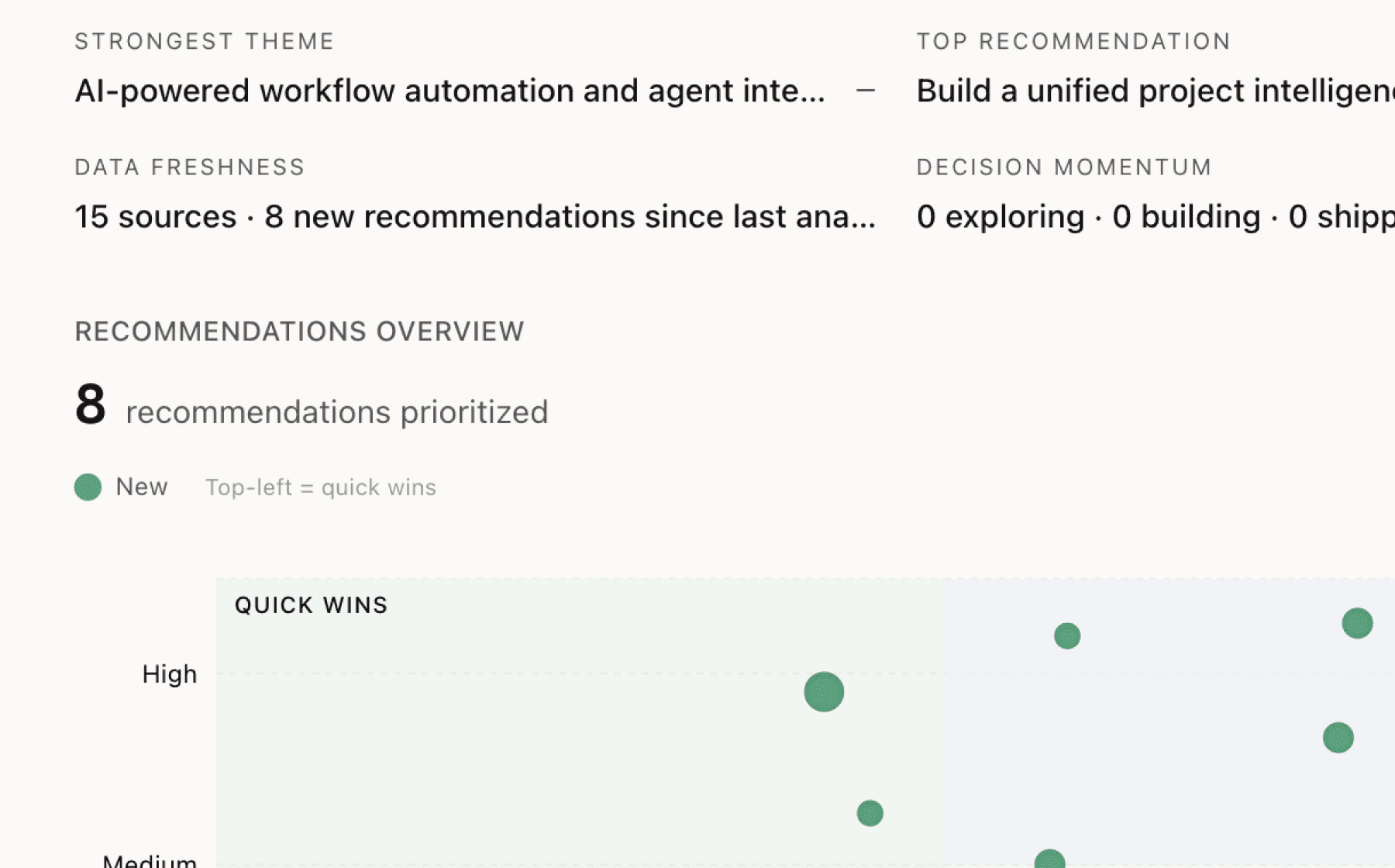
Evidence-backed insights
Every insight traces back to real customer signals. No hunches, no guesses.
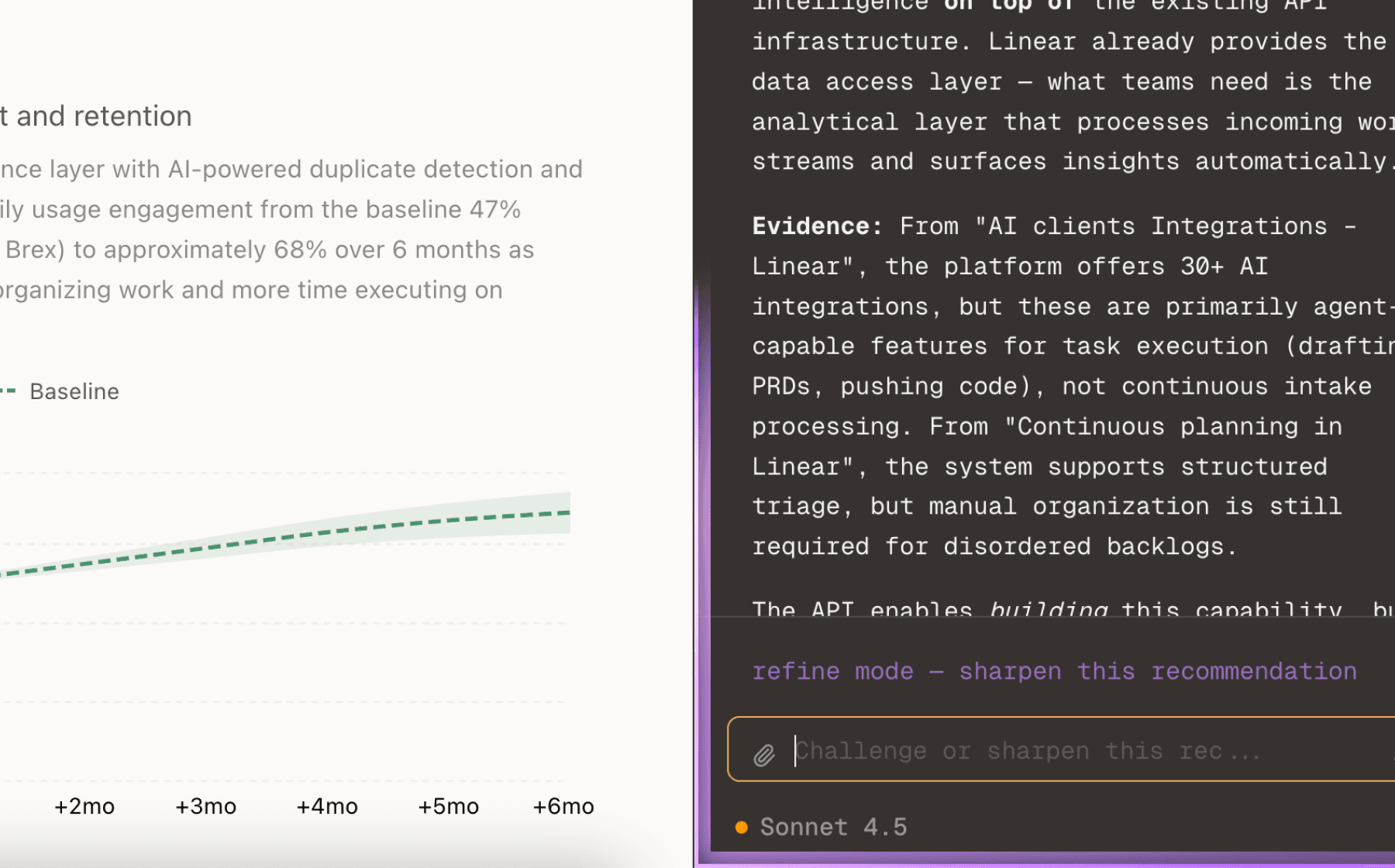
Chat with your data
Ask follow-up questions, refine recommendations, and capture business context through natural conversation.
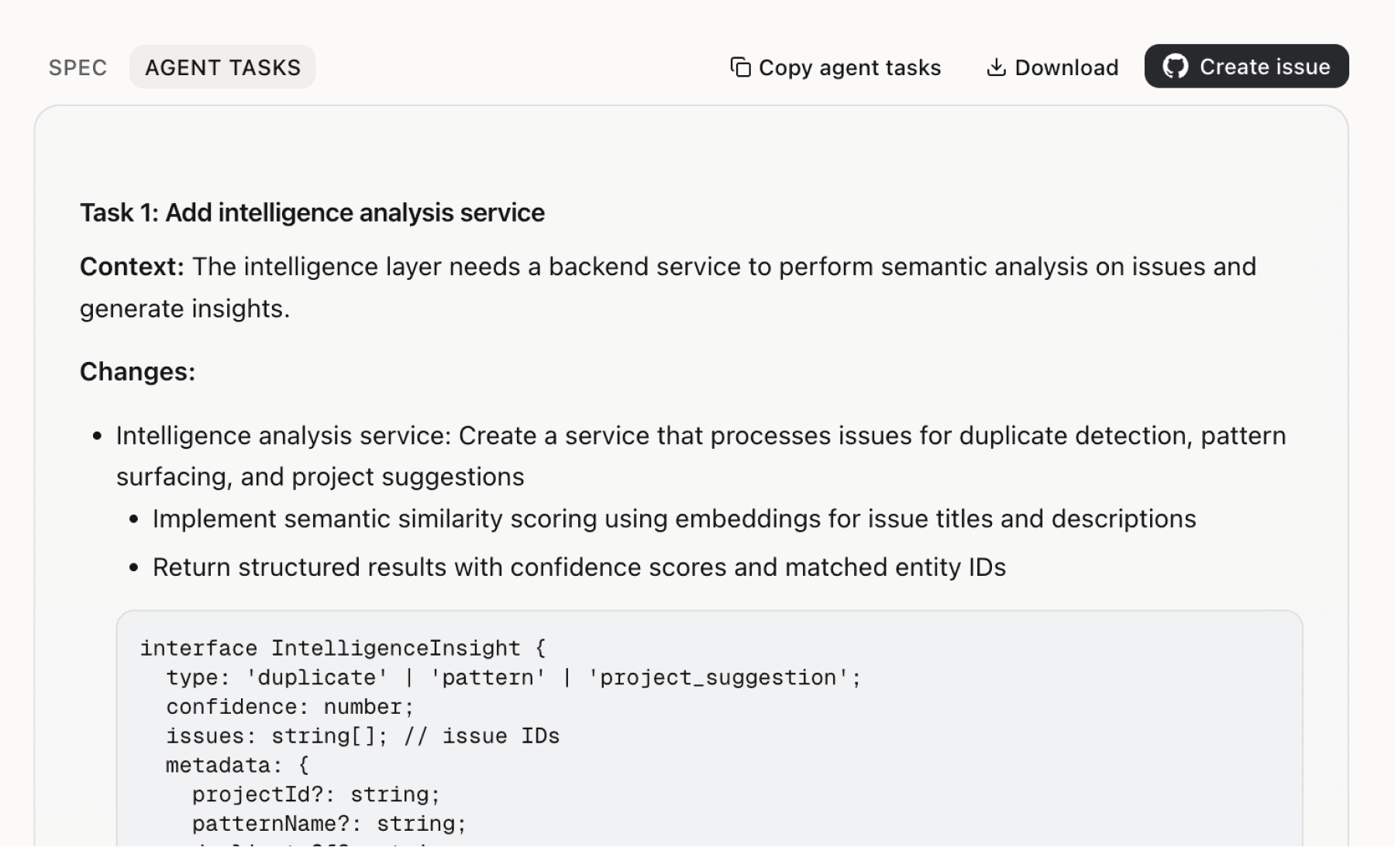
Specs your agents can ship
Go from insight to implementation spec to code-ready tasks in one click.
This analysis used public data only. Imagine what Mimir finds with your customer interviews and product analytics.
Try with your dataMore recommendations
5 additional recommendations generated from the same analysis
The platform already achieves 3x faster QA processes, but the evidence points to a more strategic opportunity around RFI prevention. Manual QA and coordination tasks create significant administrative friction, and the current approach appears reactive — speeding up existing processes rather than eliminating the need for manual review altogether. Architects need AI that continuously monitors project documents for conflicts, code violations, and coordination gaps as changes occur.
Material research appears as part of the automation suite but represents an underutilized leverage point. Architects spend considerable time researching products, comparing specifications, tracking vendor information, and ensuring selected materials meet project requirements and codes. This research is often duplicated across projects and lost when team members leave, forcing firms to rebuild vendor relationships and product knowledge repeatedly.
The platform needs AI that understands how drawings, specifications, schedules, and codes interconnect across a complete project. Current capabilities appear focused on individual task automation — speeding up schedule creation or spec writing — but architectural projects are systems where changes cascade. When a structural detail changes on a drawing, corresponding specifications need updates, affected schedules require revision, and code compliance needs re-verification.
The Studio Library centralizes firm knowledge but appears to rely on manual search rather than intelligent project matching. Architects often don't know what they don't know — they might not search for a relevant past project because they're unaware it exists or don't recognize its applicability. When starting a new healthcare project, the system should automatically surface similar healthcare projects, even if they used different terminology or had different scales, along with relevant code research and successful detail solutions.
Building codes evolve continuously, and architecture firms must ensure active projects remain compliant as regulations change. This creates ongoing administrative burden as teams manually monitor code updates, assess impacts on current work, and revise affected documentation. The platform can automate this monitoring by tracking relevant jurisdictions for each project and alerting teams when new code provisions affect their designs.
Insights
Themes and patterns synthesized from customer feedback
There is a stated need for AI capabilities that can comprehensively interpret and understand drawings, specifications, schedules, and building codes while maintaining full project context. This represents an advanced capability that would enhance the platform's ability to automate complex coordination tasks.
“AI assistant capable of interpreting drawings, specs, schedules, and codes with full project context understanding”
Avoice is structured around three core modules—Studio Assistant for AI task delegation, Studio Workflow for process automation, and Studio Library for knowledge management—enabling the platform to address multiple pain points across the architectural project lifecycle.
“Platform has three core modules: Studio Assistant (AI task delegation), Studio Workflow (automation), and Studio Library (knowledge management)”
Architecture firms face challenges searching and efficiently leveraging past project knowledge and firm standards, resulting in duplicated work and inconsistent processes. Avoice centralizes firm standards, past projects, materials, and codes into a searchable knowledge system to address this gap.
“Difficulty searching and leveraging past project knowledge and firm standards efficiently”
Avoice delivers measurable efficiency improvements through AI-powered task automation, with architects saving an average of 15 hours per week and firms realizing approximately $25k in annual productivity gains per user. The platform achieves 3x faster completion on critical deliverables like schedules, specs, and QA processes.
“Architects save an average of 15 hours per week using Avoice”
Architecture firms struggle significantly with administrative overhead, manual quality assurance and coordination tasks, and inefficient documentation workflows. These pain points directly impact delivery speed and resource allocation across the project lifecycle.
“Architecture firms struggle with administrative work, manual QA/QC coordination, and inefficient documentation processes”
Run this analysis on your own data
Upload feedback, interviews, or metrics. Get results like these in under 60 seconds.