What Clodo users actually want
Mimir analyzed 8 public sources — app reviews, Reddit threads, forum posts — and surfaced 18 patterns with 7 actionable recommendations.
This is a preview. Mimir does this with your customer interviews, support tickets, and analytics in under 60 seconds.
Top recommendation
AI-generated, ranked by impact and evidence strength
Build a voice training system that learns from user's actual sent messages to generate personalized outreach in their authentic style
High impact · Large effort
Rationale
Generic AI-generated messages achieve only 8% reply rates while personalized messages incorporating user voice and specific prospect research drive significantly better conversion. Seven sources confirm this is a critical problem — users explicitly state that AI slop doesn't convert while their own voice does. This represents the clearest path to improving the primary metric of user engagement and retention, as users will continue using a tool that demonstrably improves their reply rates.
The product already has browser extension access to see user communications across LinkedIn and email, creating a natural opportunity to learn writing patterns from messages that actually get responses. A voice training system that analyzes successful sent messages and adapts generation to match that style would directly address the core conversion problem.
This should be the top priority because it tackles the most frequently cited issue with the highest severity, directly impacts the primary success metric (engagement converts better with authentic messaging), and leverages existing data collection infrastructure. Users are already asking for this capability explicitly — the product description mentions learning user voice, suggesting this may be partially implemented but needs stronger execution.
Projected impact
The full product behind this analysis
Mimir doesn't just analyze — it's a complete product management workflow from feedback to shipped feature.
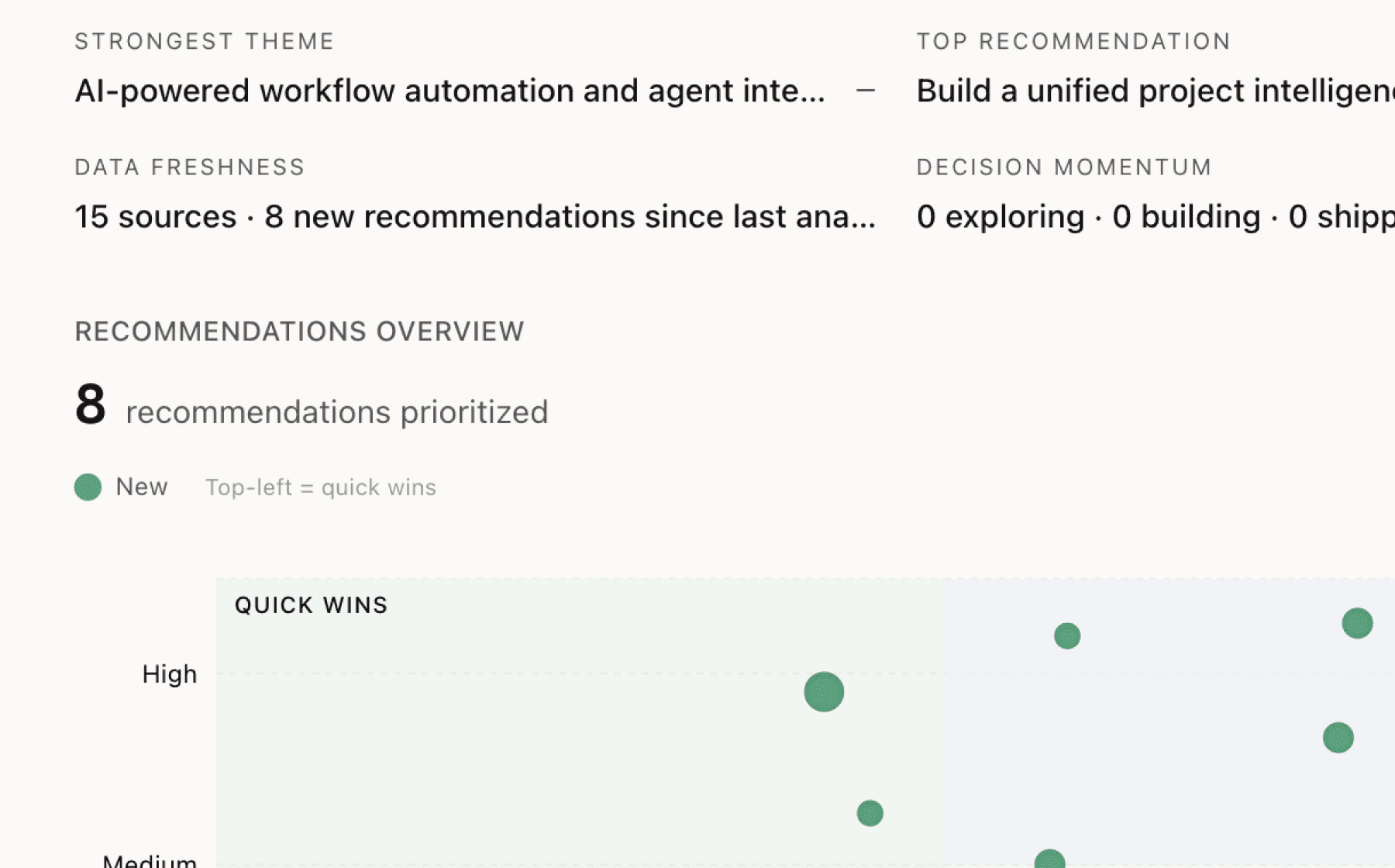
Evidence-backed insights
Every insight traces back to real customer signals. No hunches, no guesses.
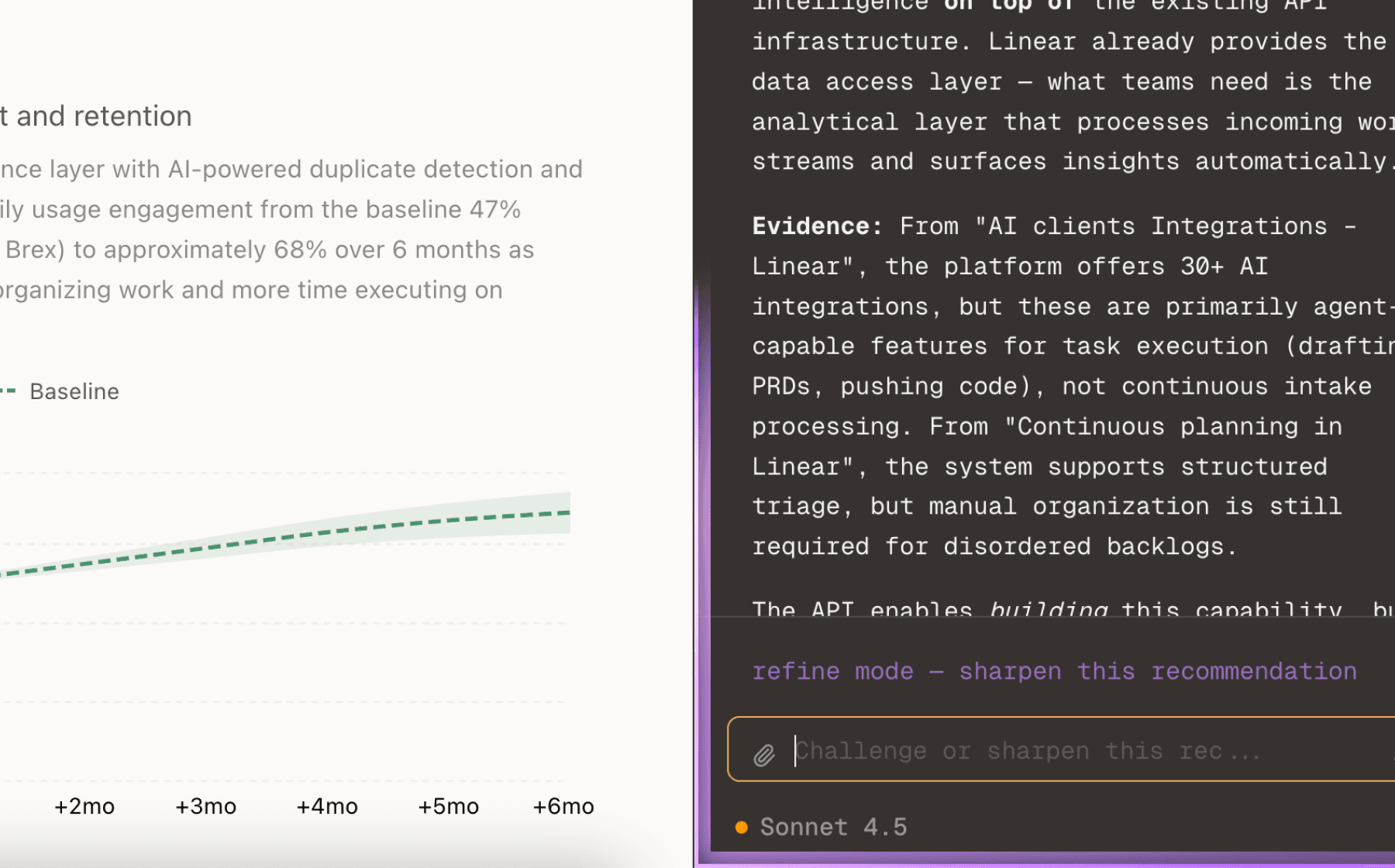
Chat with your data
Ask follow-up questions, refine recommendations, and capture business context through natural conversation.
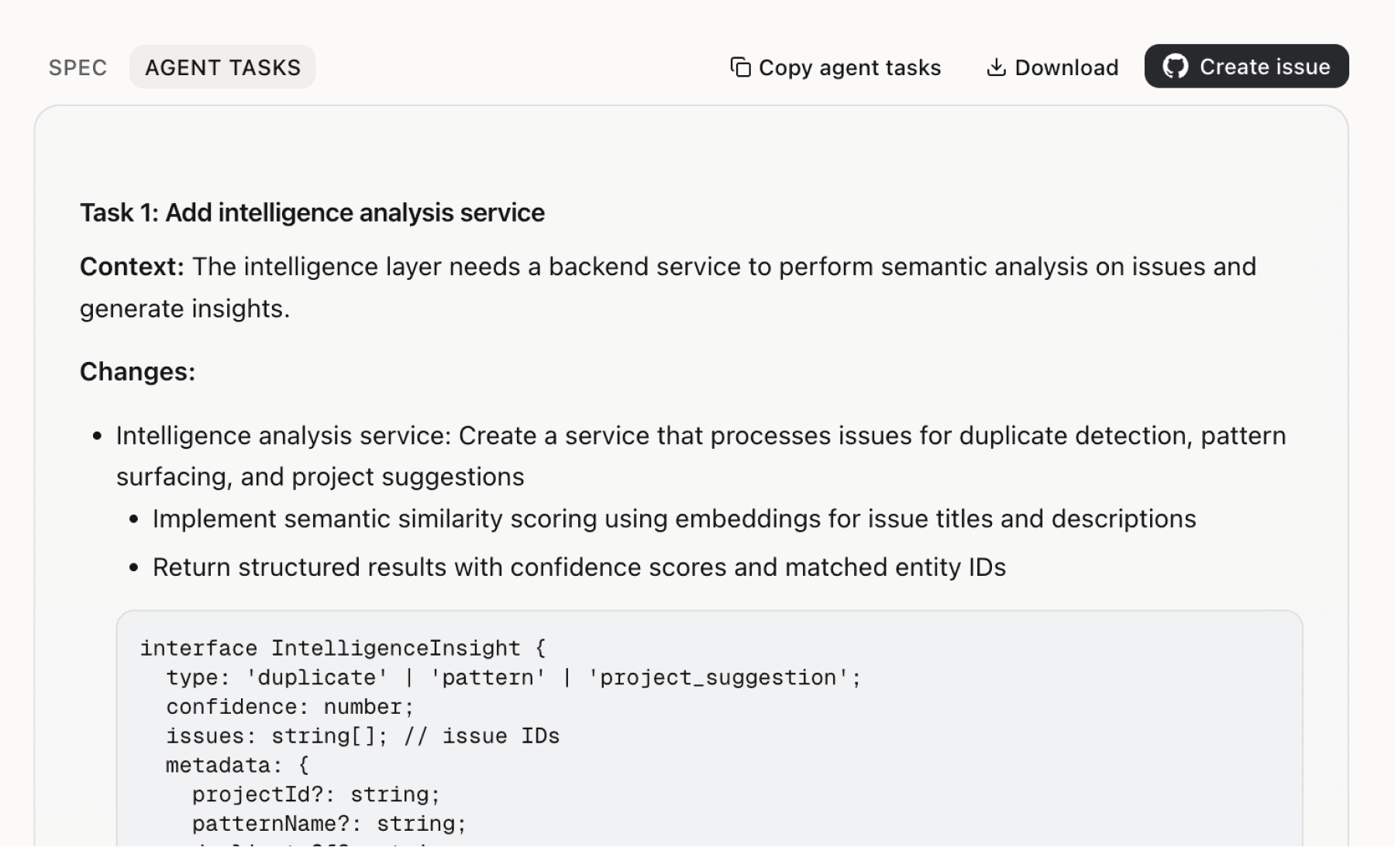
Specs your agents can ship
Go from insight to implementation spec to code-ready tasks in one click.
This analysis used public data only. Imagine what Mimir finds with your customer interviews and product analytics.
Try with your dataMore recommendations
6 additional recommendations generated from the same analysis
Users report that finding the actual people to reach out to is the hard part, and the product already demonstrates strong precision in matching target personas. Five sources confirm that speed and efficiency in lead discovery is critical, with users reporting time savings from hours to minutes. Four additional sources show users specifically requesting natural language prompt-based search for hyperspecific ICPs.
Users explicitly request dashboards tracking reply rates, meeting rates, and team performance comparisons. The product already has the data infrastructure to collect this — the browser extension sees all LinkedIn activity, messages sent, and responses received. Five sources confirm users want consolidated analytics, and Theme 0 shows specific data points users care about (questions about recent posts get 3x more replies, messages over 150 words underperform, Friday sends have low engagement).
Users explicitly request automated lead sourcing based on buying signals like job changes and company news. The product already demonstrates capability to process multiple signal types for lead evaluation, and users report strong results when timing outreach to relevant events (questions about recent posts generate 3x more replies).
Four sources document that users bear full liability for regulatory compliance with TCPA, GDPR, CCPA, CASL, and CAN-SPAM, with no support from the company. This represents a significant risk that could cause users to abandon the product or face legal consequences. For product managers and founders using the tool, regulatory violations can result in substantial fines and reputational damage.
The browser extension collects comprehensive data including keystrokes, mouse movements, personally identifiable information, and content from all visited websites while active, using this data to train ML models. For users handling sensitive customer communications or proprietary business information, this creates potential exposure. While the data collection enables the voice training and personalization features, users should have control over what gets included.
The product stores OAuth tokens for Gmail, Google Calendar, email providers, and CRM systems, granting permission to send emails, manage contacts, and read messages on behalf of users. Three sources confirm users bear responsibility for managing these credentials and permissions, but typical OAuth flows make it difficult to understand what access was granted or revoke specific permissions without disconnecting entirely.
Insights
Themes and patterns synthesized from customer feedback
Users request and would benefit from dashboards and analytics that consolidate multiple signal types, track campaign performance metrics (reply rates, meeting booking rates), and enable team-level performance comparisons. This capability appears important for continuous optimization and team scaling.
“Unified dashboard consolidating job changes, funding signals, hiring activity, and tech stack data”
Users request natural language prompt-based lead search for highly specific ICPs, automated lead sourcing based on buying signals (job changes, company news), and enriched lead profiles combining multiple data sources. These capabilities would streamline the discovery workflow further.
“Natural language prompt-based lead search for hyperspecific ICPs without manual filtering”
The company acknowledges that no transmission method is completely secure and implements only industry-standard measures, with broad liability limitations releasing the company from damages related to data collection, use, storage, or unauthorized access. Security assurances are minimal.
“Company implements industry-standard security measures but acknowledges no method of transmission is completely secure and cannot guarantee absolute security.”
Clodo stores OAuth tokens and credentials for connected services (Gmail, Google Calendar, email providers, CRM systems), granting itself permission to send emails, manage contacts, and read messages on behalf of users. Users bear responsibility for credential security and managing OAuth permissions.
“Clodo stores OAuth tokens and permissions for connected third-party services like Gmail and Google Calendar to enable real-time access for email, calendar, and message operations.”
The product enables rapid execution of personalized email campaigns with automatic scheduling, reducing manual effort in deploying multi-prospect outreach. Users see this as valuable for scaling outbound efforts without proportional time investment.
“Automated outbound emails sent and auto-scheduled in campaign”
The company shares collected user data with service providers for lead enrichment and business intelligence features, and may share data in business transfers or when legally required. Users have limited visibility into which third parties access their data.
“Third-party data enrichment services are used to supplement user-provided data and enhance lead profiles and business intelligence features.”
The company retains the right to modify, suspend, or terminate services at any time with or without notice for any reason, providing users no contractual guarantees of service continuity. This creates operational risk for teams building critical workflows around the platform.
“Company can modify, suspend, or terminate services at any time with or without notice for any reason.”
Users accept all risk of account restrictions, bans, or suspensions from LinkedIn, Gmail, or other platforms, even if caused by Clodo's service. The company provides no compensation or mitigation if platform enforcement impacts user accounts.
“Users not protected from corrective actions by third-party platforms (bans, restrictions, suspensions) even if caused by Clodo service use.”
The product supports sign-up via Google, Outlook, and work email, reducing friction for initial account creation. Sign-in options for returning users are also available, supporting multiple entry points into the platform.
“Clodo offers multiple sign-up methods: Google, Outlook, and work email registration options”
Privacy policy effective date is February 1, 2025, with last update February 12, 2026, indicating the company is actively revising terms, potentially in response to evolving regulatory requirements or service changes.
“Policy effective date is February 1, 2025, with last update on February 12, 2026, indicating recent or upcoming policy revisions.”
The Clodo browser extension collects comprehensive user activity data including keystrokes, mouse movements, personally identifiable information, and content from all visited websites while active. This data is used to train ML/AI models, creating broad exposure to personal and sensitive user communications.
“Clodo collects extensive user activity data including keystrokes, mouse movements, clicks, scroll behavior, and text input through its platform and browser extension.”
Users benefit from functionality that operates directly within familiar platforms (LinkedIn, email) without requiring context-switching or tool-hopping, reducing friction in the outbound process. This eliminates the need to copy content to separate AI tools and maintains message context throughout conversations.
“Clodo enables LinkedIn outbound without requiring copy-pasting to ChatGPT or switching between tabs—all functionality stays within LinkedIn.”
The product documentation explicitly places all responsibility for legal compliance (TCPA, GDPR, CCPA, CASL, CAN-SPAM, email deliverability, voice recording consent) on users, with no guarantees from the company. This creates significant liability exposure for GTM leaders using the platform for outbound campaigns.
“Users bear full liability and responsibility for compliance with TCPA, Do Not Call laws, and call recording consent requirements when using voice AI features.”
User data may be transferred, stored, and processed in countries with potentially weaker data protection laws than the user's jurisdiction, with no explicit guarantees about where data resides or who has access. This creates additional compliance risk for organizations subject to strict data residency or sovereignty requirements.
“Data may be transferred, stored, and processed in countries outside user's jurisdiction, including the United States, with potentially different data protection laws.”
The product provides no warranties on the accuracy or reliability of AI-generated content, placing full responsibility on users to review and verify all output before use. This creates operational risk if users rely on generated content without thorough validation.
“AI-generated content provided without accuracy or reliability warranties; users solely responsible for reviewing and verifying all AI output before use.”
Users and market research consistently show that generic AI-generated messages underperform, while personalized messages that reflect individual writing style and incorporate specific research signals achieve significantly better results. This represents a key differentiator for improving conversion rates in GTM campaigns.
“AI slop doesn't convert. Your voice does.”
Users consistently report significant time savings in identifying and qualifying leads, with the product enabling discovery of highly targeted prospects in hours rather than previous manual processes taking substantially longer. This directly addresses a core pain point in outbound execution and appears to be the primary value driver for user engagement.
“This is really helpful... before, I had to spend one hour searching on external websites.”
Users report that the product reliably identifies prospects matching their ideal customer profile with high accuracy, reducing wasted outreach effort on poor-fit leads. This precision in targeting appears critical to campaign effectiveness and user confidence in the product.
“This is a direct hit. Directly my ICP, it's finding the exact people I need.”
Run this analysis on your own data
Upload feedback, interviews, or metrics. Get results like these in under 60 seconds.