
What Golpo AI users actually want
Mimir analyzed 2 public sources — app reviews, Reddit threads, forum posts — and surfaced 8 patterns with 5 actionable recommendations.
This is a preview. Mimir does this with your customer interviews, support tickets, and analytics in under 60 seconds.
Top recommendation
AI-generated, ranked by impact and evidence strength
Build segment-specific templates and input workflows to accelerate time-to-first-video for each user cohort
High impact · Medium effort
Rationale
The product serves six distinct segments with fundamentally different content structures and success metrics—L&D teams create training modules with learning objectives, marketers create ad variations with CTAs, educators create lesson plans with curriculum standards. Currently all segments use the same generic document-to-video flow, forcing each user to translate their domain-specific content into a format Golpo can process. This translation friction directly limits videos per user in the critical first session when adoption patterns form.
Segment-specific templates would provide pre-configured structures matched to each workflow—training video templates with knowledge checks for L&D, lesson plan templates with standards alignment for educators, ad templates with hook-body-CTA structure for marketing. These templates reduce the cognitive load of first-time creation and increase the likelihood users create multiple videos in their initial session, establishing the habit that drives long-term volume per user.
This recommendation addresses the core business question of accelerating both metrics simultaneously. Faster time-to-first-video increases conversion and activation rates (revenue growth), while reducing friction in subsequent creations drives videos per user. The six-segment reality makes this a high-leverage intervention—each template unlocks volume across an entire cohort.
Projected impact
The full product behind this analysis
Mimir doesn't just analyze — it's a complete product management workflow from feedback to shipped feature.
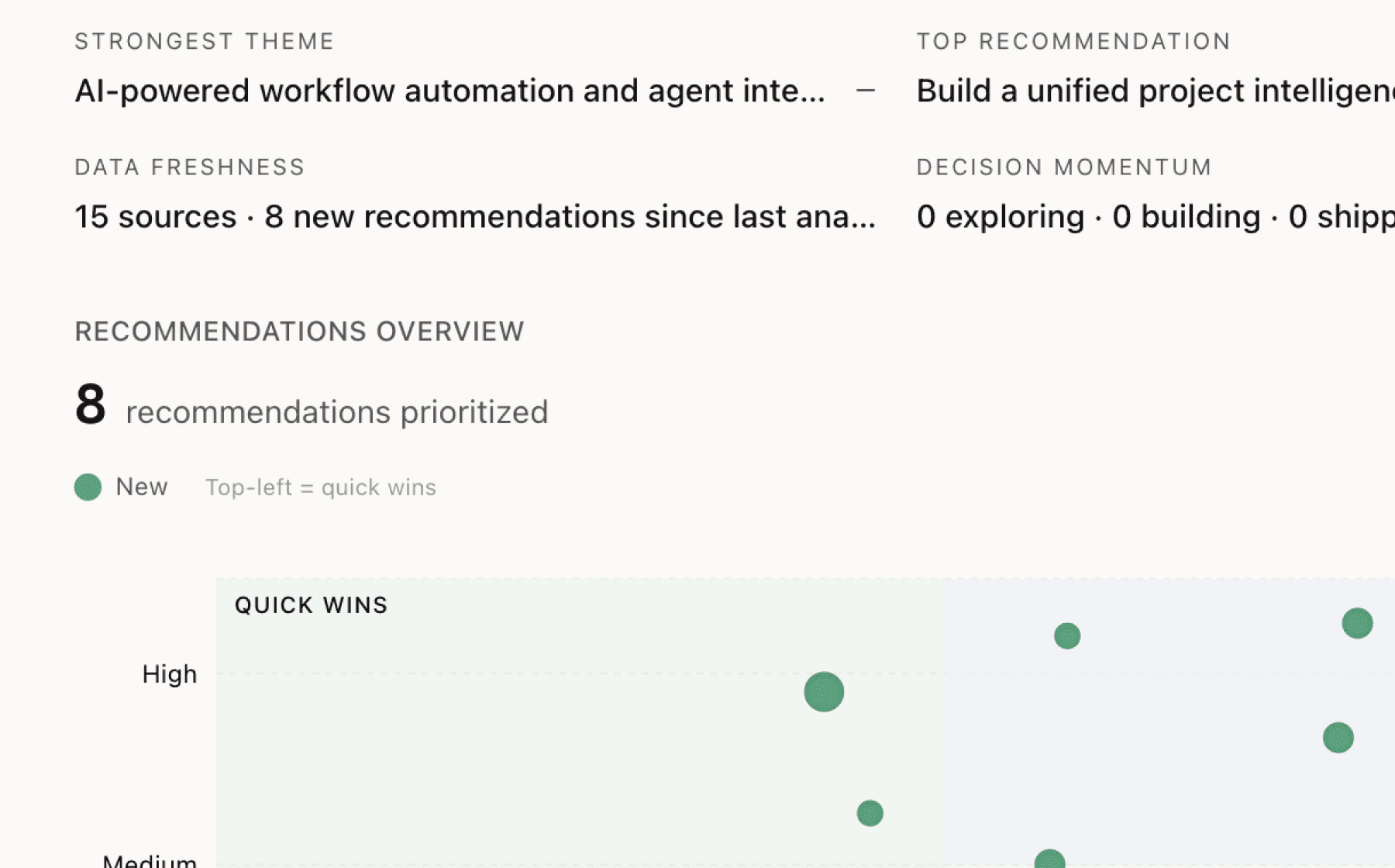
Evidence-backed insights
Every insight traces back to real customer signals. No hunches, no guesses.
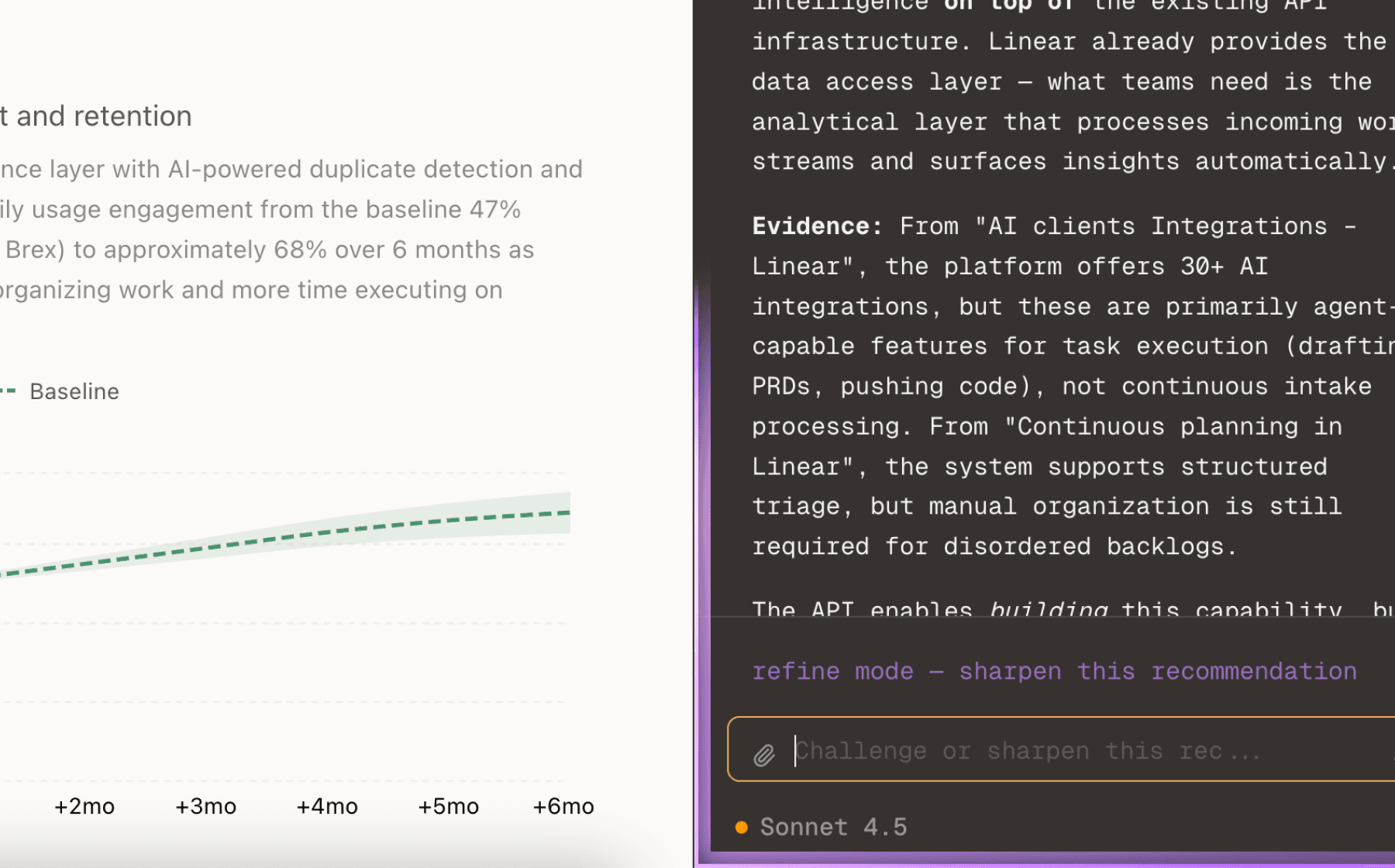
Chat with your data
Ask follow-up questions, refine recommendations, and capture business context through natural conversation.
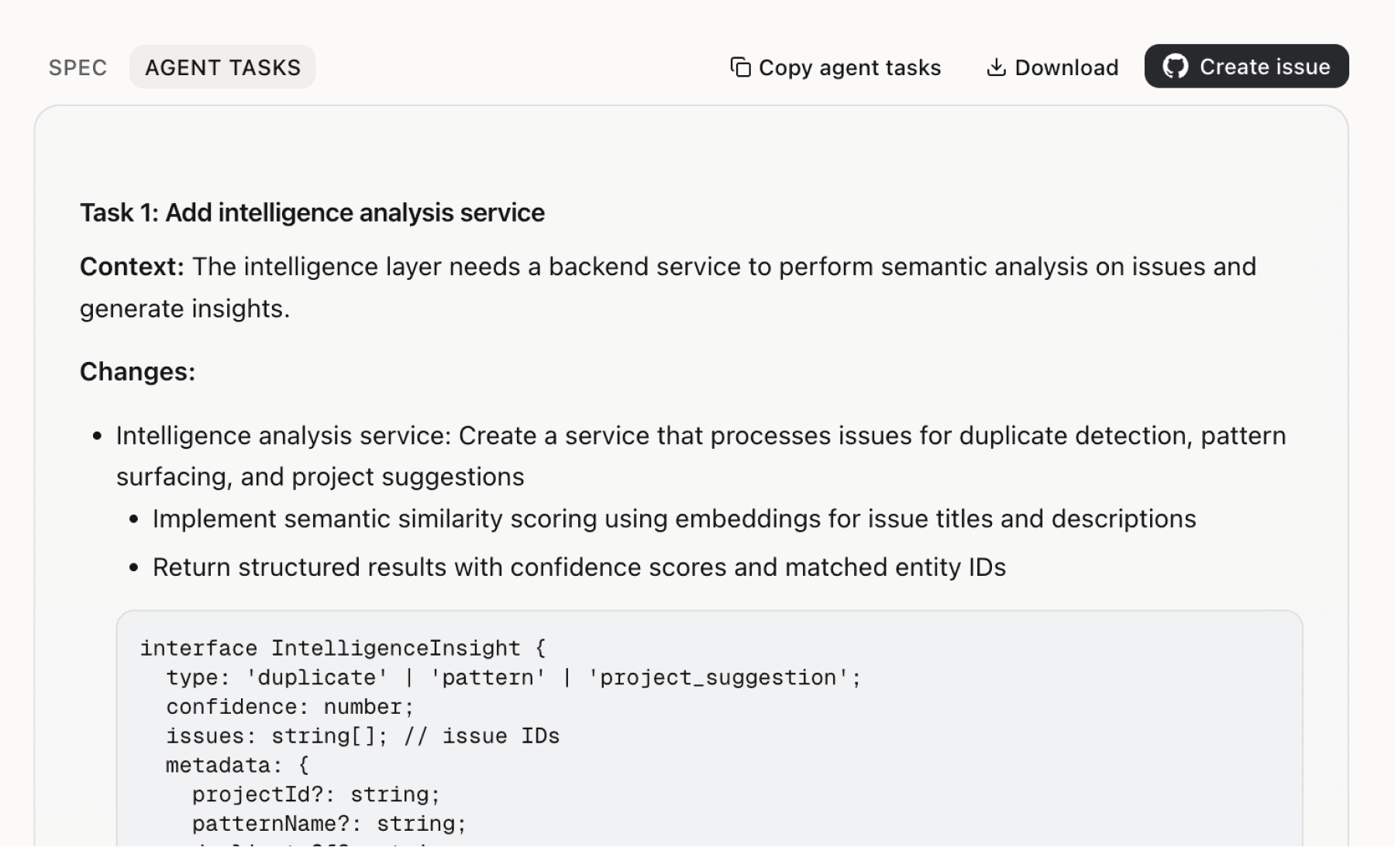
Specs your agents can ship
Go from insight to implementation spec to code-ready tasks in one click.
This analysis used public data only. Imagine what Mimir finds with your customer interviews and product analytics.
Try with your dataMore recommendations
4 additional recommendations generated from the same analysis
Users currently process documents one at a time, creating an artificial ceiling on videos per user even after the product successfully removes technical barriers. The evidence shows Golpo eliminates the manual production bottleneck, but the interaction model still requires serial processing—upload one document, generate one video, repeat. For L&D teams with training libraries, educators with semester curricula, and content creators with content calendars, this serial workflow prevents the exponential growth in videos per user that automation should enable.
Marketing teams explicitly need to scale ad creation with unlimited video variations, but the current product generates one output per input. This forces marketers to manually create separate inputs for each variation they want to test, reintroducing the manual bottleneck Golpo was designed to eliminate. The same constraint limits other segments—L&D teams can't easily generate department-specific versions of the same training, content creators can't test different hooks for the same core content.
Users currently visit Golpo when they need a video, treating it as a destination tool rather than infrastructure. This episodic usage pattern caps videos per user because creation requires active intent and context switching. Internal comms teams already create weekly briefings, educators already plan semester curricula, content creators already maintain publishing calendars—but none of these workflows currently connect to Golpo, requiring manual triggering for each video.
Current evidence suggests Golpo optimizes for individual content creators converting their own documents into videos, but organizational buyers in L&D, HR, and internal comms operate with team-based workflows involving subject matter experts, reviewers, and approvers. Without built-in collaboration features, these teams resort to external tools for review cycles, creating friction that slows both adoption velocity and ongoing usage volume.
Insights
Themes and patterns synthesized from customer feedback
Beyond direct sales, Golpo offers API access and an affiliate program, creating multiple pathways to reach users and embed video creation into existing workflows and partner platforms. This distribution strategy can accelerate user acquisition and videos-per-user metrics by making Golpo available through partners' existing customer bases.
“Golpo AI offers API access and an affiliate program, indicating multi-channel distribution strategy beyond direct sales”
While Golpo automates the core video generation, it provides editing controls for scenes, voice, and style, allowing users to customize output without requiring full re-creation. This balance enables faster iteration and higher-quality outputs tailored to brand or content requirements, supporting both the speed and quality dimensions of the growth challenge.
“Videos maintain script-to-visuals alignment with fast speed (minutes to first draft) and editing controls for scenes, voice, and style.”
Golpo raised $4.1M in seed funding in 2025, providing capital to accelerate product development, expand user acquisition, and scale operations across the six target segments. This funding supports the investment needed to drive both videos-per-user growth and revenue expansion simultaneously.
“Golpo raised $4.1M in seed funding in 2025”
Golpo's founding team includes Stanford AI researchers and brothers who previously spent years manually creating educational content, providing deep domain knowledge of both the technical AI challenges and the pain points of manual video production. This background directly informs the product design and positions the team to iterate on the core friction points users face.
“Backed by Y Combinator and built by Stanford AI researchers; founders are brothers who previously spent years creating educational content manually.”
Unlike most AI video tools that prioritize visual effects and avatars, Golpo is designed to optimize for understanding and clarity using a whiteboard explainer format. This design choice—combining an instructor's ability to simplify complexity, engineering precision, and storytelling clarity—aligns with the needs of L&D, education, and internal comms segments where comprehension and retention are the success metrics.
“Most AI video tools optimize for spectacle (avatars, effects, cinematic polish); Golpo optimizes for understanding and clarity instead.”
Golpo automates the entire video creation pipeline—storyboarding, visuals, narration, and timing—without requiring user editing, enabling users to generate finished videos in minutes from documents, slides, or prompts. This automation directly addresses the core bottleneck in video volume per user and supports faster revenue growth by reducing time-to-creation and enabling batch processing.
“Golpo AI converts documents, slides, and prompts into whiteboard-style explainer videos automatically, handling storyboard, visuals, narration, and timing without user editing.”
Golpo serves six distinct segments—L&D teams, marketing, educators, HR & onboarding, internal communications, and content creators—each with different motivations (employee retention, ad scaling, student engagement, onboarding efficiency, team alignment, audience growth). This breadth creates opportunity to grow videos per user and revenue simultaneously, but also requires balancing feature priorities and messaging across divergent needs.
“Product serves six distinct user segments: L&D teams, marketing, educators, HR & onboarding, internal communications, and content creators”
Users currently face significant friction converting documents and ideas into videos—requiring specialized editors, software skills, and hours of manual work (scripting, recording, post-production). This bottleneck keeps valuable content trapped in documents and slides, directly limiting the volume of videos teams can produce per user and the speed at which they can scale content creation.
“Sharing ideas visually is currently too slow and technical, requiring editors, software, and time; friction keeps great ideas stuck in documents and slide decks.”
Run this analysis on your own data
Upload feedback, interviews, or metrics. Get results like these in under 60 seconds.