What Pickle users actually want
Mimir analyzed 6 public sources — app reviews, Reddit threads, forum posts — and surfaced 14 patterns with 8 actionable recommendations.
This is a preview. Mimir does this with your customer interviews, support tickets, and analytics in under 60 seconds.
Top recommendation
AI-generated, ranked by impact and evidence strength
Build public privacy dashboard showing real-time verification of enclave operations and data flow
High impact · Medium effort
Rationale
Pickle's architectural privacy guarantees are technically exceptional but largely invisible to users. Twenty-two sources describe end-to-end encryption, hardware isolation, and verifiable builds, yet these controls only matter if users can actually see them working. Users currently must trust GitHub code reviews and remote attestation concepts most cannot evaluate themselves.
A dashboard surfacing enclave attestation status, showing which data categories are being processed, displaying encrypted data flow diagrams, and providing one-click verification of current build integrity would transform abstract technical claims into tangible daily proof. This directly addresses the trust barrier blocking adoption while reinforcing the data ownership promise that differentiates Pickle from typical AI companies.
This capability becomes especially critical as Pickle 1 hardware launches with always-on cameras and microphones. Users need continuous visible confirmation that ambient capture is working as promised, not just assurance in marketing materials.
Projected impact
The full product behind this analysis
Mimir doesn't just analyze — it's a complete product management workflow from feedback to shipped feature.
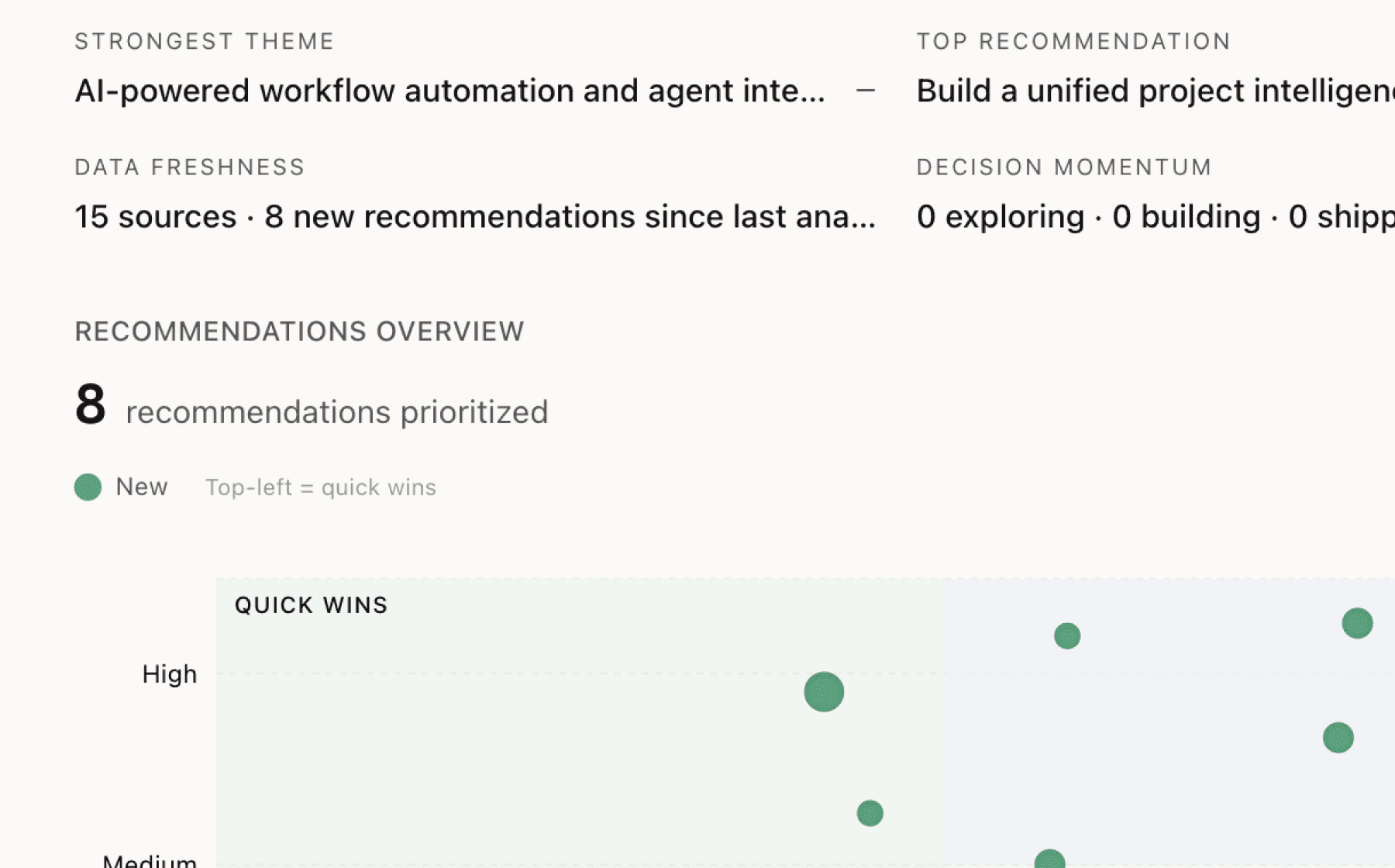
Evidence-backed insights
Every insight traces back to real customer signals. No hunches, no guesses.
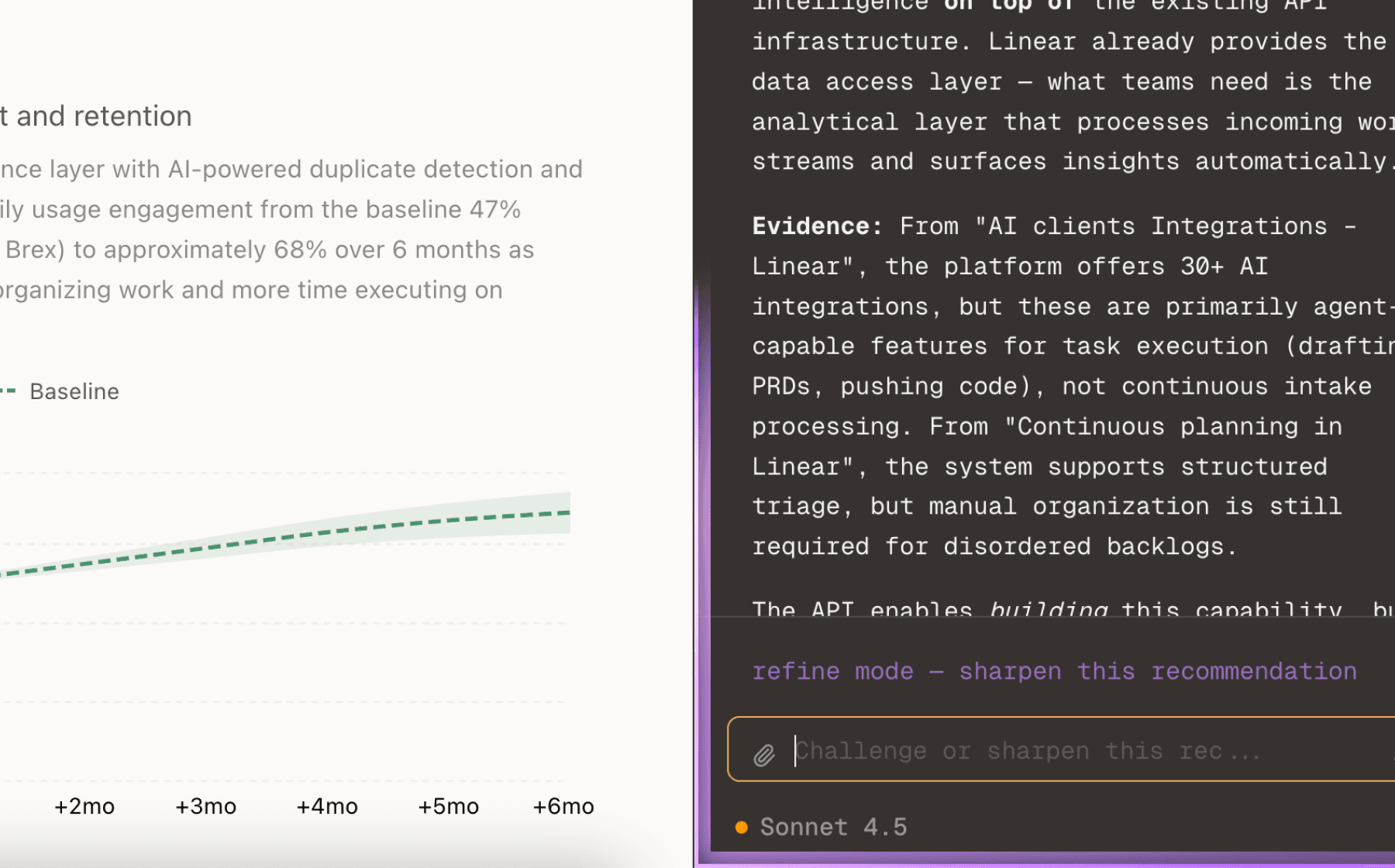
Chat with your data
Ask follow-up questions, refine recommendations, and capture business context through natural conversation.
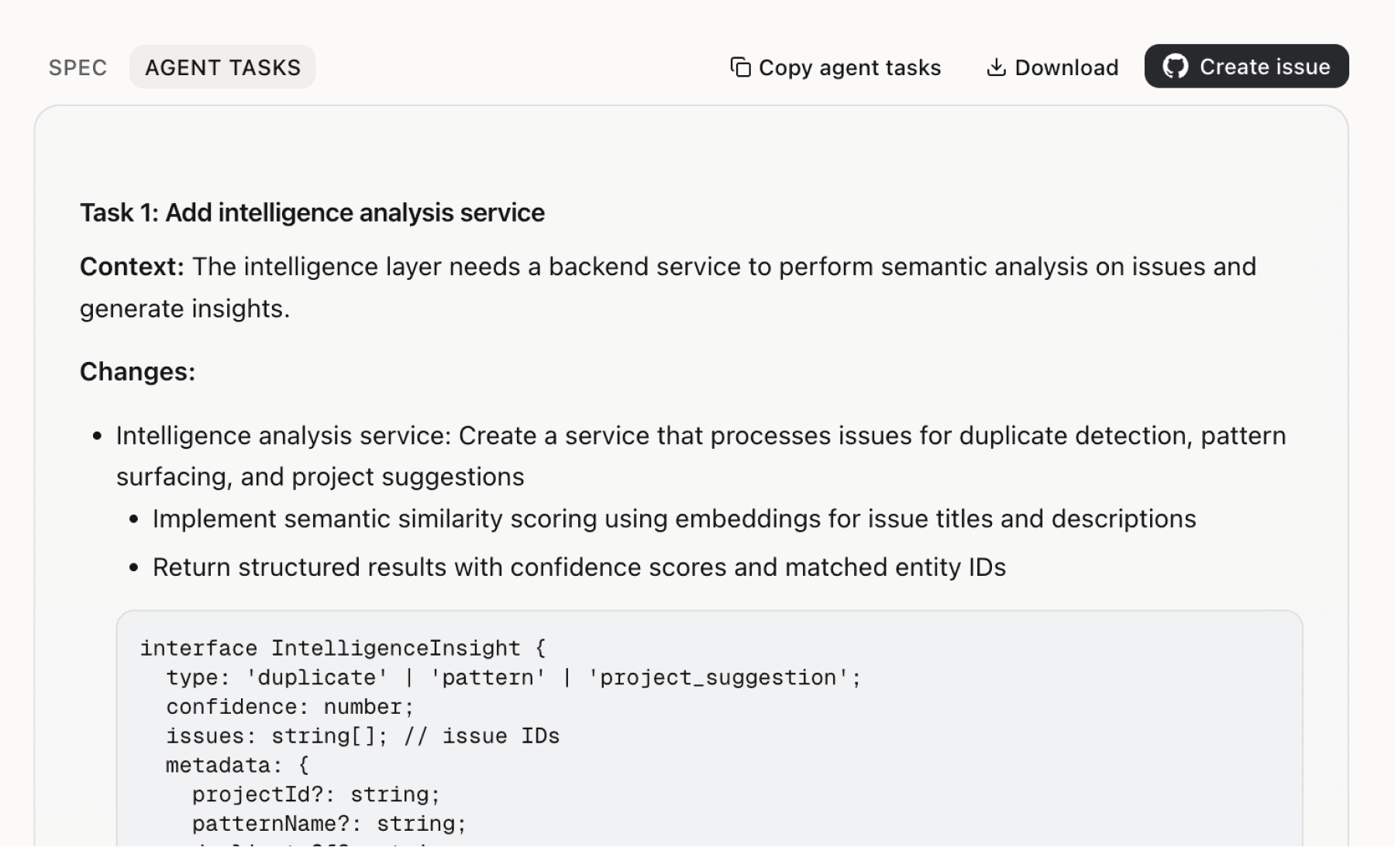
Specs your agents can ship
Go from insight to implementation spec to code-ready tasks in one click.
This analysis used public data only. Imagine what Mimir finds with your customer interviews and product analytics.
Try with your dataMore recommendations
7 additional recommendations generated from the same analysis
Two users described unexpected self-discovery through interacting with their memory system, with one stating it helped them understand themselves better and another saying they started expressing things they didn't know they had in them. This intrinsic motivation for self-understanding represents untapped engagement potential beyond task completion.
Users can stop context capturing via voice, gesture, or touch, but this control mechanism lacks the visceral immediacy required for high-stakes privacy moments. When someone walks into a confidential meeting or receives unexpected sensitive information, they need to know with absolute certainty that capturing has stopped and captured content can be immediately destroyed.
Pickle's infinite memory creates the foundation for anticipatory intelligence, yet the current interaction model still appears primarily reactive. Nine sources describe the system remembering every interaction and retrieving context from six years ago, but this capability only demonstrates value when users explicitly query it. True ambient intelligence should surface relevant information at the moment it becomes useful without requiring a request.
Pickle currently integrates with Gmail, Notion, and Slack, but these represent only a fraction of where professional context lives. Product managers and engineering leads spend significant time in Linear, Jira, Figma, GitHub, and calendar applications. Each missing integration creates a gap in the memory system that reduces the AI's ability to provide relevant suggestions and undermines the promise of comprehensive contextual understanding.
Pickle OS for Team is coming soon, but the implementation approach will determine whether it becomes a genuine collaboration platform or just individual memory systems with sharing bolted on. Product teams need shared understanding of user needs, design decisions, and technical constraints. A centralized knowledge base that multiple people can contribute to and query would address the collective intelligence gap that limits team alignment.
Batch 2 ships Q4 2026 with always-on cameras and microphones, a fundamentally different privacy proposition than software-only offerings. Users who paid $899 and committed to $200 annual subscriptions have high expectations and will judge the product within the first week of use. If they don't quickly develop fluency with privacy controls and confidence in the ambient capture model, early returns and negative word-of-mouth will undermine the launch.
SOC2 certification and open-source code provide static verification, but users need ongoing proof that privacy promises hold under real-world operation at scale. Publishing quarterly transparency reports showing total number of enclave attestations performed, memory purge requests executed, accounts deleted with complete data removal, and any security incidents or breaches would demonstrate continuous accountability.
Insights
Themes and patterns synthesized from customer feedback
Batch 1 sold out; Batch 2 available at $899 with $200/year Pickle OS Pro subscription. US Q4 2026 shipping with international rollout 1-2 quarters later. 12-hour battery and lens customization options indicate hardware-software bundling strategy to drive adoption.
“Batch 1 of Pickle 1 sold out; Batch 2 available at $899 with $200/year Pickle OS Pro subscription due today and $699 due at shipping”
Pickle maintains SOC2 certification, uses ZDR Enterprise contracts, and implements automatic security updates to ensure ongoing compliance and system stability. These operational controls support user confidence in the platform's security posture and ability to scale.
“Product is SOC2 certified, indicating security and compliance standards are met”
Chat features and additional third-party integrations are planned to expand data collection sources and deepen user stickiness. Team collaboration features are launching to enable shared knowledge and organizational alignment, signaling evolution beyond individual memory toward collective intelligence.
“Chat feature and additional integrations are coming soon to expand data collection sources”
Pickle positions itself beyond typical AI as a 'soul computer' designed to amplify human agency and help users shape the life they want. This emotional and philosophical differentiation establishes a unique brand identity that appeals to values-driven users seeking AI that respects autonomy.
“Pickle positions itself as a 'soul computer' - personal intelligence designed to amplify human agency and help users shape the life they want”
Pickle 1 features a lightweight aluminum body with water resistance to sweat and light rain, designed as a daily-wear device. Physical durability supports the ambient intelligence value proposition by ensuring the device can reliably remain active throughout a user's day.
“Pickle 1 designed for all-day outdoor use with lightweight durable aluminum body; water-resistant to sweat and light rain but not fully waterproof”
Users can adjust context capturing at a detailed level, instantly disable capturing via voice/gesture/touch, customize avatar appearance and voice, selectively process data by category, and easily delete accounts with complete data removal. These visible control mechanisms address privacy anxiety and give users confidence in their data autonomy.
“Users can stop capturing context instantly via voice commands, gestures, or touch, and immediately discard memories”
Pickle 1 AR glasses (launching Q4 2026) enable continuous ambient context capturing through cameras and microphones, automatically detecting user needs and delivering proactive suggestions directly in the user's visual field. This hardware form factor fundamentally changes how the system captures context and delivers value compared to software-only alternatives.
“Pickle 1 is a hardware product (AR glasses) launching Q4 2026, positioning Pickle OS as a wearable intelligence interface requiring smartphone tethering”
Pickle's product strategy spans Pickle OS (software), Pickle 1 (AR hardware), web/app platforms, and planned team collaboration features, with integrations into Gmail, Notion, and Slack. This ecosystem approach enables richer context collection and positions Pickle as a cross-platform operating system rather than a single-device product.
“Product ecosystem includes both Pickle OS (software) and Pickle 1 (hardware device), suggesting multi-platform strategy”
Pickle automatically detects user intent in real-time from ambient context and provides proactive suggestions for actions, content, and products before users explicitly ask. This capability reduces decision-making friction and creates a qualitatively different engagement model than reactive AI assistants.
“Pickle 1 anticipates user needs in real-time, automating actions like rides, messages, reservations, and shopping”
Users report unexpected self-awareness and deeper personal insight as they interact with their indexed memory and accumulated context, suggesting engagement is driven not only by task completion but by reflection and self-understanding. This taps into intrinsic motivation for continued use.
“It actually kinda freaked me out. I started saying things I didn't even know I had in me.”
Pickle targets three distinct user segments—Learners (knowledge digestion), Creators (ideation/writing), and Doers (organization/context management)—each with different engagement and retention drivers. Differentiated value propositions across these segments suggest the need for tailored onboarding, feature emphasis, and retention strategies.
“Product targets three user segments: Learners (knowledge digestion), Creators (ideation/writing), and Doers (organization/context management)”
Pickle implements multiple technical layers—end-to-end encryption, hardware-isolated enclaves, local processing, and open-source transparency—that structurally prevent Pickle from accessing user data. Users can independently verify privacy claims through public GitHub code, remote attestation, and reproducible builds rather than relying on trust alone.
“Pickle's core architecture encrypts data by default and decrypts only inside hardware-isolated enclaves, ensuring even Pickle cannot access plaintext data”
Pickle's core differentiator is seamlessly collecting, organizing, and retrieving personal context across all sources going back 6 years, creating an ever-growing memory system ('Bubbles') that makes the AI increasingly relevant and proactive over time. This capability directly drives engagement by enabling the system to anticipate user needs rather than waiting for explicit requests.
“Evolves understanding by remembering every user interaction to improve over time”
Pickle commits to never selling user data, never training models on user content, and granting users full data ownership with limited revocable processing licenses. This foundational business promise directly differentiates Pickle from typical AI companies and addresses a core trust barrier for adoption.
“Users retain full ownership of their data; Pickle grants only a limited, encrypted, revocable license to process content for service delivery”
Run this analysis on your own data
Upload feedback, interviews, or metrics. Get results like these in under 60 seconds.