What Polymorph users actually want
Mimir analyzed 4 public sources — app reviews, Reddit threads, forum posts — and surfaced 11 patterns with 6 actionable recommendations.
This is a preview. Mimir does this with your customer interviews, support tickets, and analytics in under 60 seconds.
Top recommendation
AI-generated, ranked by impact and evidence strength
Build a visual intelligence dashboard that shows exactly which behavioral signals triggered each routing decision
High impact · Medium effort
Rationale
Users need to trust automated routing before they'll rely on it for revenue-critical sales workflows. Right now the system detects pricing page visits, SSO checks, and competitor comparisons, then routes leads automatically — but there's no visibility into why a specific lead was flagged or what pattern triggered the action. Product managers and founders making the buying decision need proof the system works before committing.
This transparency layer should show a timeline of signals detected (e.g. "Visited pricing 3x in 2 days → Checked SOC 2 doc → Corporate email domain"), the confidence score, and the routing decision made. This builds trust during evaluation and helps users refine signal definitions post-purchase.
The unified customer intelligence model already captures this data across product analytics, revenue touchpoints, and behavioral events. Surface it in a way that turns black-box automation into explainable intelligence — users will convert faster when they can see the system catching what they'd miss manually.
Projected impact
The full product behind this analysis
Mimir doesn't just analyze — it's a complete product management workflow from feedback to shipped feature.
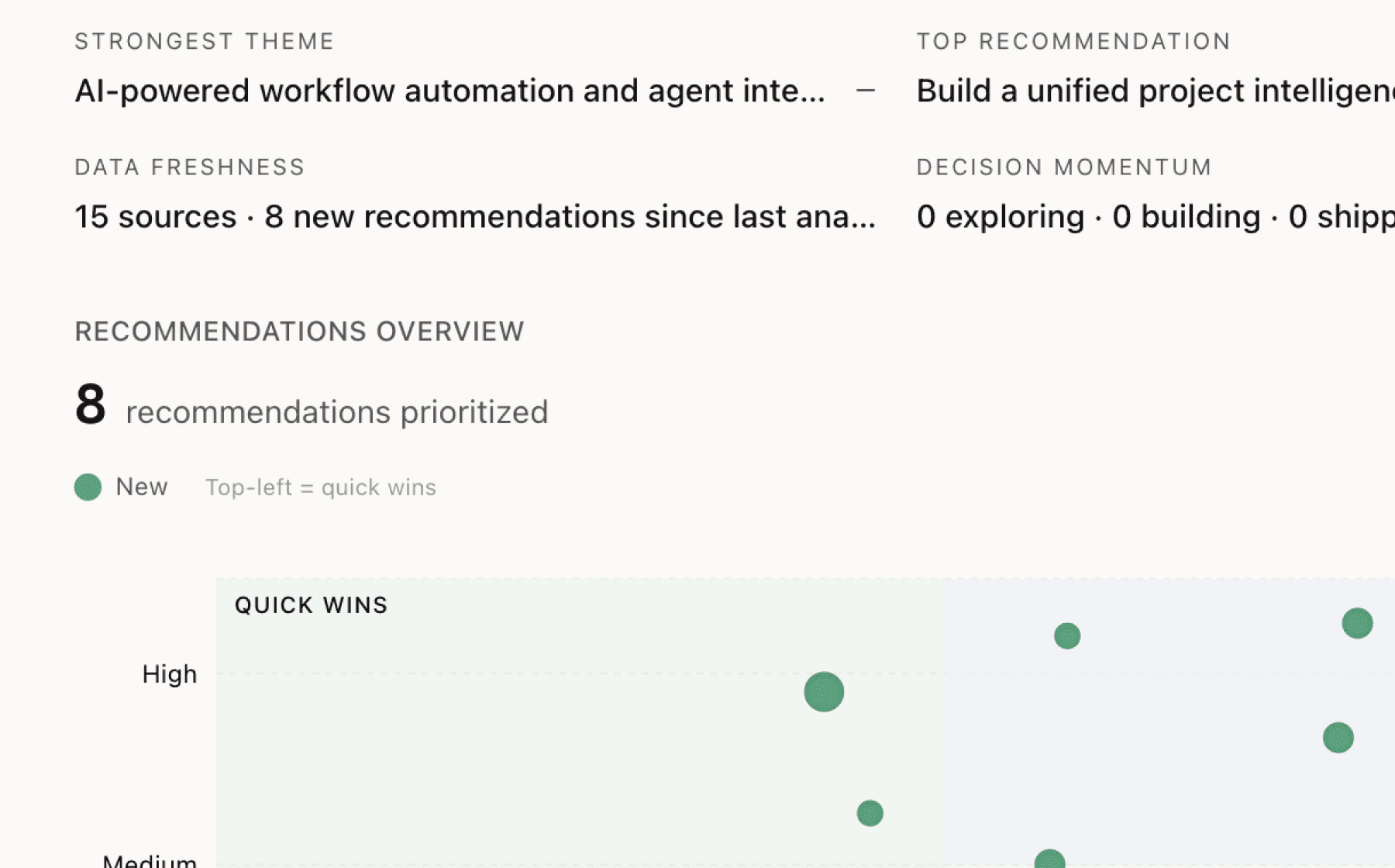
Evidence-backed insights
Every insight traces back to real customer signals. No hunches, no guesses.
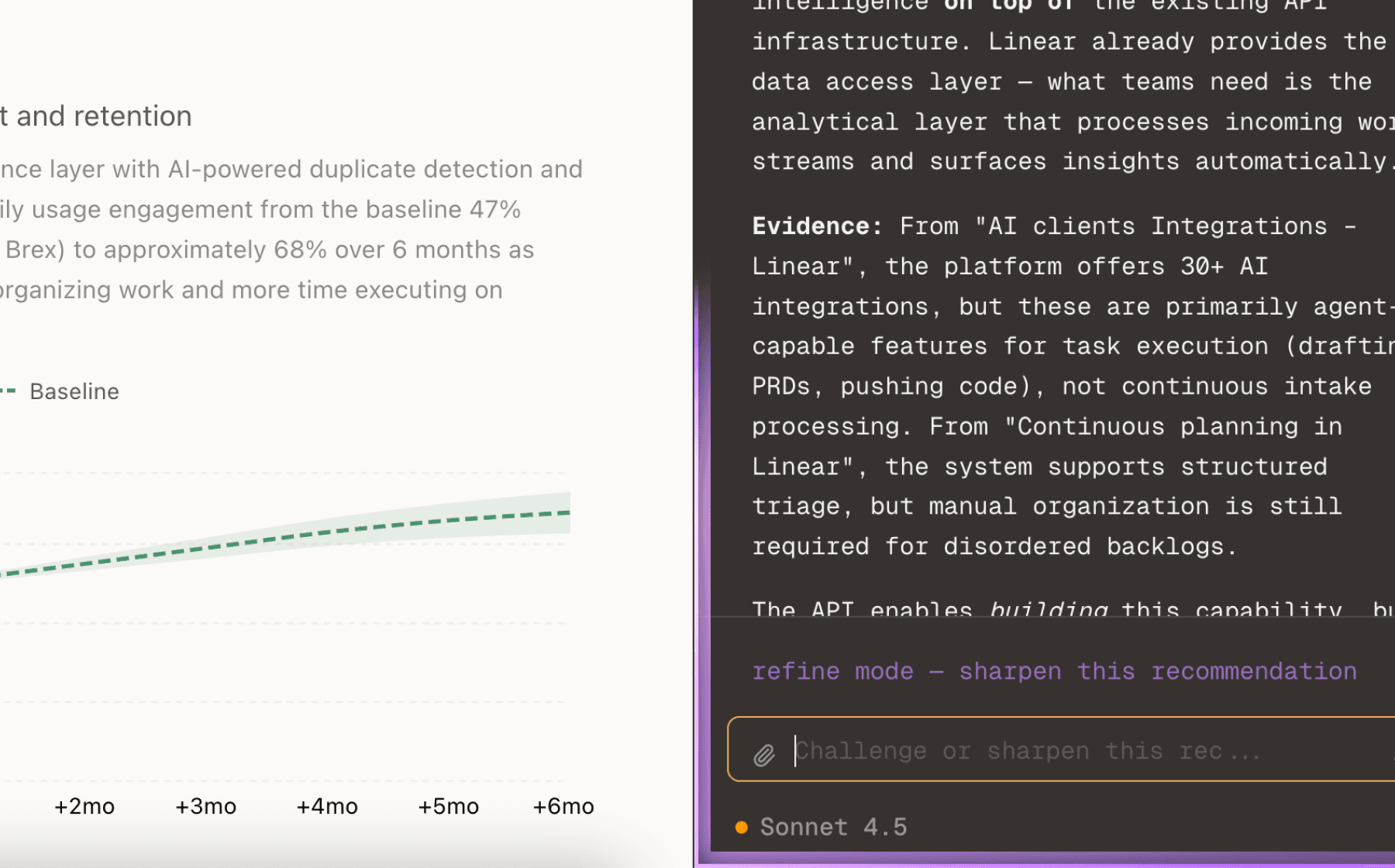
Chat with your data
Ask follow-up questions, refine recommendations, and capture business context through natural conversation.
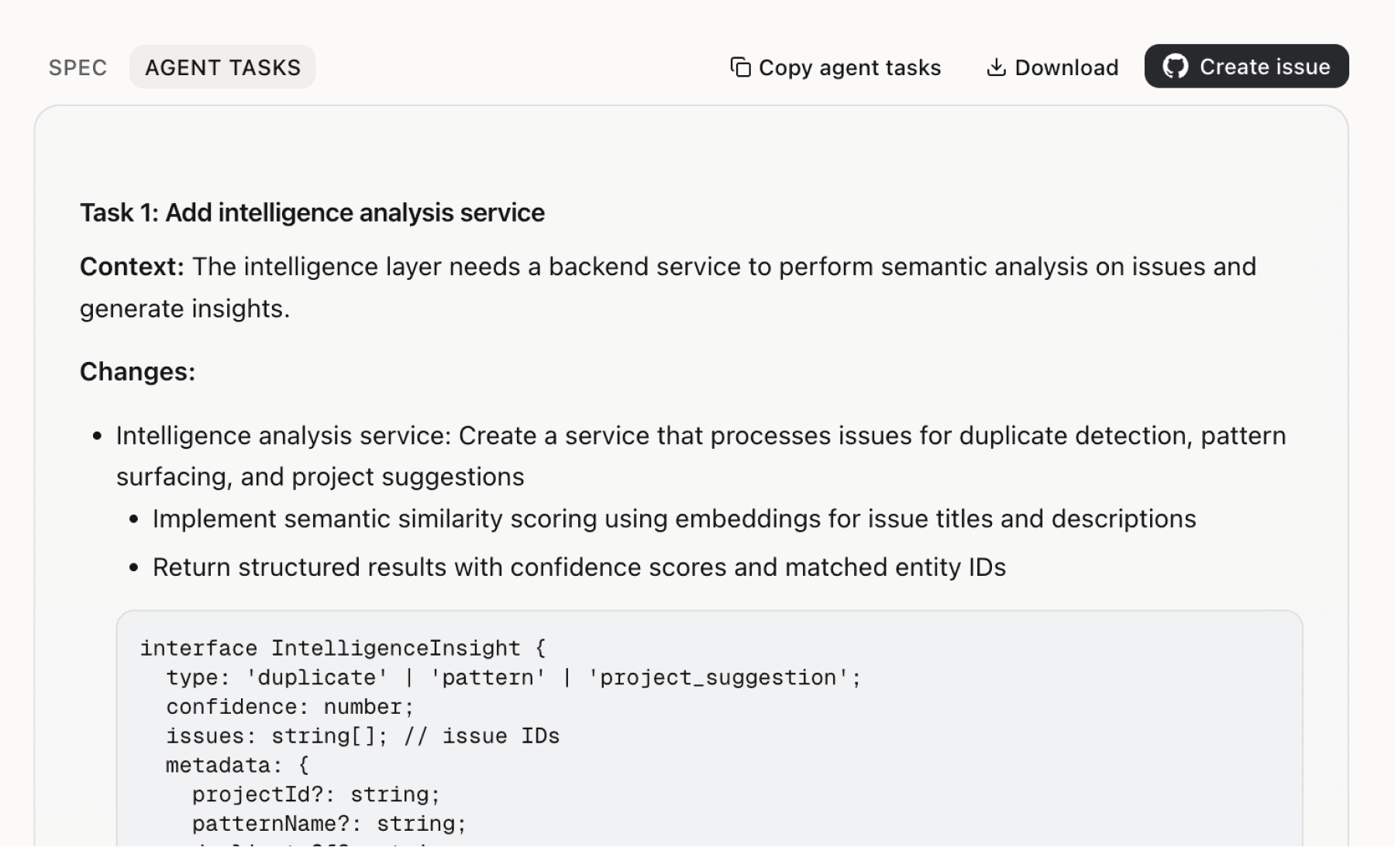
Specs your agents can ship
Go from insight to implementation spec to code-ready tasks in one click.
This analysis used public data only. Imagine what Mimir finds with your customer interviews and product analytics.
Try with your dataMore recommendations
5 additional recommendations generated from the same analysis
The platform's integration speed (minutes vs weeks) and compatibility with existing stacks (Snowflake, PostHex, Datadog, HubSpot) removes a major adoption barrier, but the private beta status suggests onboarding may still require manual setup or support handholding. Users evaluate products by time-to-value, and product managers won't champion a tool internally unless they can demo results in the first meeting.
The current churn detection catches users at 80%+ quota with 10+ days remaining, which is a good mechanical signal but misses behavioral context. Some users at 75% quota who are ramping up usage velocity represent higher conversion opportunity than users sitting at 85% with flat usage. The recommendation engine should factor in trajectory, not just absolute position.
The terms of service state services are provided 'as is' without uptime guarantees, and the company can suspend accounts without notice. For a platform that routes revenue-critical sales leads and detects churn in real time, this creates adoption risk for buyers who need customer intelligence in production workflows. Product managers won't champion a tool that could go dark during a critical sales quarter.
The platform already detects when trial users view competitor comparisons and sends personalized case studies, but this is a generic response to a specific threat. Not all competitor evaluations are equal — a user comparing against an established analytics platform has different concerns than one comparing against a lightweight CRM add-on.
The terms state users retain data ownership and the company doesn't sell personal information, which addresses basic enterprise concerns. But customer intelligence platforms process sensitive behavioral data across product usage, revenue events, and communication records — buyers need more detail about retention periods, data residency options, subprocessor lists, and deletion procedures.
Insights
Themes and patterns synthesized from customer feedback
Terms of service state services are provided 'as is' without guarantee of uptime or error-free operation, and the company reserves the right to suspend accounts without notice. Liability is capped at fees paid in the preceding 12 months, which creates financial and operational uncertainty for production-critical use cases.
“Services are provided 'as is' and 'as available' without warranties, including no guarantee of uninterrupted, error-free, or completely secure operation”
Polymorph explicitly states that users retain full ownership of submitted data while the company receives a limited license to process it solely for service delivery and improvement. This data ownership clarity addresses enterprise customer concerns about data control and aligns with GDPR and CCPA obligations.
“Users retain ownership of all data submitted to the Services; Polymorph receives limited license to use, process, and store customer data solely to provide and improve the Services”
The platform identifies trial users who are viewing competitor comparison content and proactively sends personalized case studies to increase likelihood of conversion. This targeted intervention at the moment of highest vulnerability (competitor evaluation) addresses a key churn risk during evaluation periods.
“Personalized case studies sent to active trial evaluators viewing competitor comparisons”
The platform automatically collects pages visited, features used, timestamps, and interaction patterns to analyze how users engage with the product. This comprehensive behavioral tracking feeds the customer intelligence model but requires explicit user awareness and consent management.
“Usage data collected automatically includes pages visited, features used, timestamps, and interaction patterns to analyze user behavior”
Polymorph is currently in private beta with early access available by request, indicating the platform is still under active development. This early-stage status may impact feature completeness, API stability, and long-term product commitment for production deployments.
“Polymorph is currently in private beta with early access available by request”
The platform reserves the right to change pricing with reasonable notice, and all fees are non-refundable unless explicitly stated otherwise. This contract flexibility aligns with SaaS norms but creates budget predictability challenges for cost-conscious buyers.
“All fees are non-refundable unless otherwise stated; company reserves right to change pricing with reasonable notice”
The platform integrates with popular analytics platforms (PostHex, Datadog), CRMs (HubSpot), data warehouses (Snowflake), and communication systems in minutes rather than weeks without requiring data migration. This low-friction onboarding removes a primary adoption barrier for product and engineering teams.
“Platform integrates with popular analytics platforms, CRMs, marketing tools, and communication systems with setup taking minutes rather than weeks”
The platform identifies users approaching plan quotas (80%+ usage with 10+ days remaining) as high churn risk and high upgrade opportunity, then recommends personalized upgrade paths to prevent attrition. This automated detection targets the moment when user value expectation exceeds available capacity.
“Users approaching plan limits with 80%+ quota usage and 10+ days remaining”
The platform automatically processes millions of behavioral signals—including email domain patterns, SSO checks, document reads, page visits, and feature toggles—without requiring users to define rules or write custom queries. This automated intelligence extraction reduces operational overhead for maintaining churn and intent detection.
“System detects latent demand signals such as competitor comparison page visits and team plan toggling”
Polymorph automatically identifies high-intent signals (pricing page visits, team size indicators, competitor comparisons, security document reads) and routes leads to appropriate sales resources in real time. This behavioral pattern matching enables demos to be booked before prospect research is complete, compressing sales cycles and capturing intent before it cools.
“Polymorph automatically routes high-intent enterprise leads to Account Executives based on behavioral signals like team size and pricing page visits”
The platform integrates product analytics, revenue data, marketing touchpoints, support interactions, and call/email records into a single continuously-updated customer model, eliminating the need for users to stitch together multiple disconnected dashboards. This unified view enables decision-grade customer understanding rather than isolated event tracking.
“Polymorph provides a customer intelligence platform that unifies product events, revenue data, marketing touchpoints, and human interactions into decision-grade customer models”
Run this analysis on your own data
Upload feedback, interviews, or metrics. Get results like these in under 60 seconds.